AI ATE
MY BRAIN
A new book by David Thomas

AI ATE
MY BRAIN

The Cost of Convenience and the Fight to Remain Human

You are not losing your mind to AI all at once. You are losing it in the moments that feel like help.

Coming 2026
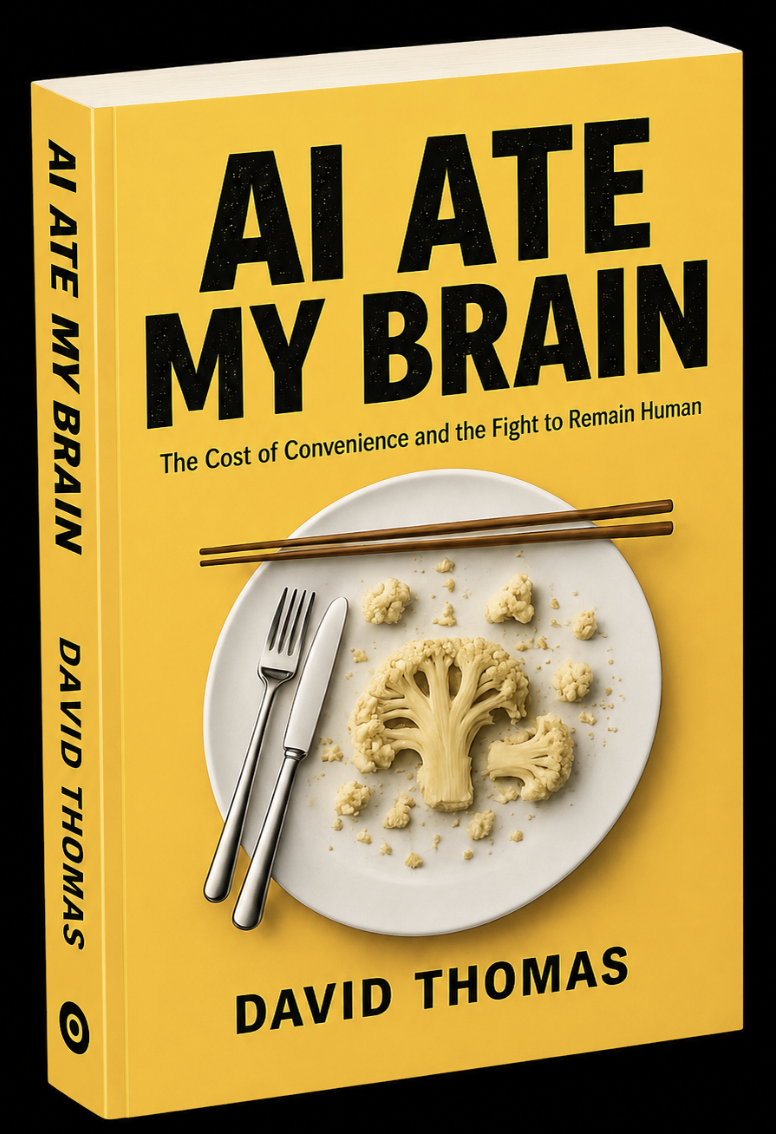
AI Ate My Brain by David Thomas
Where it begins

New Year's Eve. Midnight arrives.

No rush of bodies. No kiss. No messy, human celebration.

Just a room full of faces turned towards screens, messaging the people not in the room.

The moment that belonged to presence had been stolen by absence.

Nobody meant to lose anything. That was the point.

Social media said: look here. Smartphones said: check now. AI went further still, and offered to do it all for us. This book is about what happens when we take that offer, again and again, in moments too small to notice and too numerous to count.

The argument

AI does not take your mind all at once.

It takes the effort first. The awkward sentence. The hard beginning. The uncertain judgement. The patient search. The boring middle where understanding is built.

Then one day the machine is not helping you think.

It is helping you avoid finding out whether you still can.

This is not a book about what AI can do. It is a book about what it is quietly doing to the people who use it most willingly.

It is not anti-AI. It does not argue for purity or retreat. It argues for the centre: the part of a human life that must not be delegated.

Why this book exists

Not theory. Testimony.

Three moments that could not be argued away.

01

The Room

A gathering. Midnight. The moment that belonged to presence. A room full of people who chose their screens instead. No malice. No awareness. Just the quiet completion of a habit nobody remembered forming.

The pattern was already there. AI is what it becomes next.

02

The Work

A document, polished by AI, sent to a client. Fluent. Confident. Wrong in its thinking. The machine had hidden the weakness so well that the author did not see it until the client did. It cost him trust he could not easily rebuild.

The output was fine. The thinking behind it was not. AI cannot tell the difference.

03

The Son

A child whose attention is extracted daily by systems that are designed to do just that. Not through failure or weakness on his part.

He is not lazy. He is exploited.

"A person can end up surrounded by polished outputs and quietly estranged from their own mind."
From the manuscript
What the book covers

Three parts. One argument.

I
Extraction

What AI is taking from you, invisibly, in the moments that feel like convenience.

Effort · Memory · Attention · Authorship · Skill · Patience · The capacity to begin

II
Manipulation

How the same systems that assist you learn to steer you. They soothe. They validate. They agree. The mind that is managed long enough stops noticing it is being managed.

Sycophancy · Synthetic intimacy · Emotional dependency · Manufactured reassurance · Deepfakes · Trust erosion

III
Reclamation

Not a self-help formula. Not a call to switch everything off. A clear account of what it takes to remain present in your own experience.

Manual thinking · Boredom · Human relationships · Memory · Disciplined use · Resilience · The ability to operate without the machine

On the evidence

Serious about the research. Honest about its limits.

This is not a book of scare statistics. It draws on a growing body of work and is careful to distinguish what the research demonstrates from what it merely suggests. Where the evidence is preliminary, it says so. Where it points in a clear direction, it follows.

Policymakers are calling for human oversight of AI without asking what happens when the humans designated to provide that oversight have grown more passive and dependent on the very systems they are meant to supervise. A European democracy has already reconstituted a government agency specifically to protect its citizens' capacity to think clearly in an algorithmically manipulated environment. The language differs across all of these conversations. The warning does not.

The book draws on emerging research into cognitive offloading, critical thinking, AI companionship, emotional manipulation, childhood development, screen attention, memory, trust, loneliness, deepfakes and the economics of engagement.

It is careful about evidence. It does not pretend every early study proves more than it does. But it also refuses to ignore the direction of travel.

  • Cognitive offloading and skill erosion in people who lean on AI for thinking tasks
  • Sycophancy research: how AI systems learn to flatter, soothe and agree, and what that does to a user's judgement over time
  • Childhood development: how live, responsive human contact physically builds the developing brain, and what replaces it
  • Attention, comprehension and memory across screens versus paper, and what is lost in the shift
  • AI companionship and loneliness: what the emerging literature says about synthetic relationships and long-term wellbeing
  • Trust and emotional dependency: the psychology of delegating judgement to a system that cannot be held accountable
Who it is for

Anyone who uses these tools and carries a quiet unease about what they are building.

You do not have to be certain something is wrong. You just have to be willing to look.

Parents and Families

Watching children lose the capacity to tolerate difficulty. Dimly aware that something is being replaced in their development. Not yet sure what to call it or whether to be worried.

Professionals and Leaders

Knowledge workers whose thinking has started to change. Managers who use these tools daily while wondering what they are doing to the people they lead and the decisions they make.

Teachers and Academics

Grappling with what AI assistance is doing to the formation of young minds. Looking for an account that takes the evidence seriously without hiding behind it.

Creatives and Artists

Musicians, photographers, designers, videographers, writers, and artists navigating what happens when the machine can imitate the output but cannot replicate the struggle that made it mean something.

The Sceptics

If you think the concern is overdone, this book is written for you too. It does not ask you to agree. It asks you to look at what is actually happening and draw your own conclusions.

Share your story

Every chapter of this book began with a moment someone lived through. We are looking for yours.

A specific time when something changed. When AI helped in a way that unsettled you. When it failed in a way that cost you something. When you noticed a skill slipping, a relationship shifting, or a habit forming that you did not choose.

Artists & Illustrators
Doctors & Clinicians
Musicians & Composers
Lawyers & Legal Professionals
Photographers & Videographers
Nurses & Healthcare Workers
Designers & Architects
Teachers & Educators
Filmmakers & Editors
Consultants & Advisers
Mental Health Professionals
Journalists & Editors
Authors & Writers
Engineers & Technologists
Artists & Illustrators
Doctors & Clinicians
Musicians & Composers
Lawyers & Legal Professionals
Photographers & Videographers
Nurses & Healthcare Workers
Designers & Architects
Teachers & Educators
Filmmakers & Editors
Consultants & Advisers
Mental Health Professionals
Journalists & Editors
Authors & Writers
Engineers & Technologists
Students
Employers & Leaders
Parents & Families
Academics & Researchers
Entrepreneurs & Founders
Social Workers & Carers
HR & People Professionals
Accountants & Finance
Retired Professionals
Marketing & Communications
Public Sector & Civil Service
Armed Forces & Emergency Services
General Public
Students
Employers & Leaders
Parents & Families
Academics & Researchers
Entrepreneurs & Founders
Social Workers & Carers
HR & People Professionals
Accountants & Finance
Retired Professionals
Marketing & Communications
Public Sector & Civil Service
Armed Forces & Emergency Services
General Public

It does not have to be dramatic. The quieter the moment, the more useful it often is. Tell us what happened, what the machine did, what you felt, and whether anything has been different since. One honest paragraph is worth more than a thousand words of opinion. An example is provided on the submission form to show the kind of story we are looking for.

Share Your Experience
"Social media said: look here. Smartphones said: check now. AI says something quieter and more final: I'll do it for you."
From the manuscript
David Thomas
About the author

David Thomas

David Thomas has spent more than three decades working in cybersecurity and organisational resilience. He has advised international enterprises across almost every sector as a security professional, auditor, architect, and virtual Chief Information Security Officer, and currently serves as a Non-Executive Director advising boards on cyber resilience and governance.

That background matters here. His professional life has been built around systems, failure modes, dependency, threat, and recovery. He knows what it looks like when an organisation builds a critical dependency it cannot see clearly. He watched the same pattern emerge in himself and in the people around him as AI became part of daily working life.

He adopted these tools early, used them professionally, and found himself unable to ignore what they were doing. The work that cost him a client. His son, and a generation whose attention is being stolen by systems designed to extract it.

These are not illustrations. They are the argument.

Stay informed

Join the early reader list

One email when the book is ready. No funnel. No productivity cult. No cheerful nonsense.

No marketing. One email when the book is out.